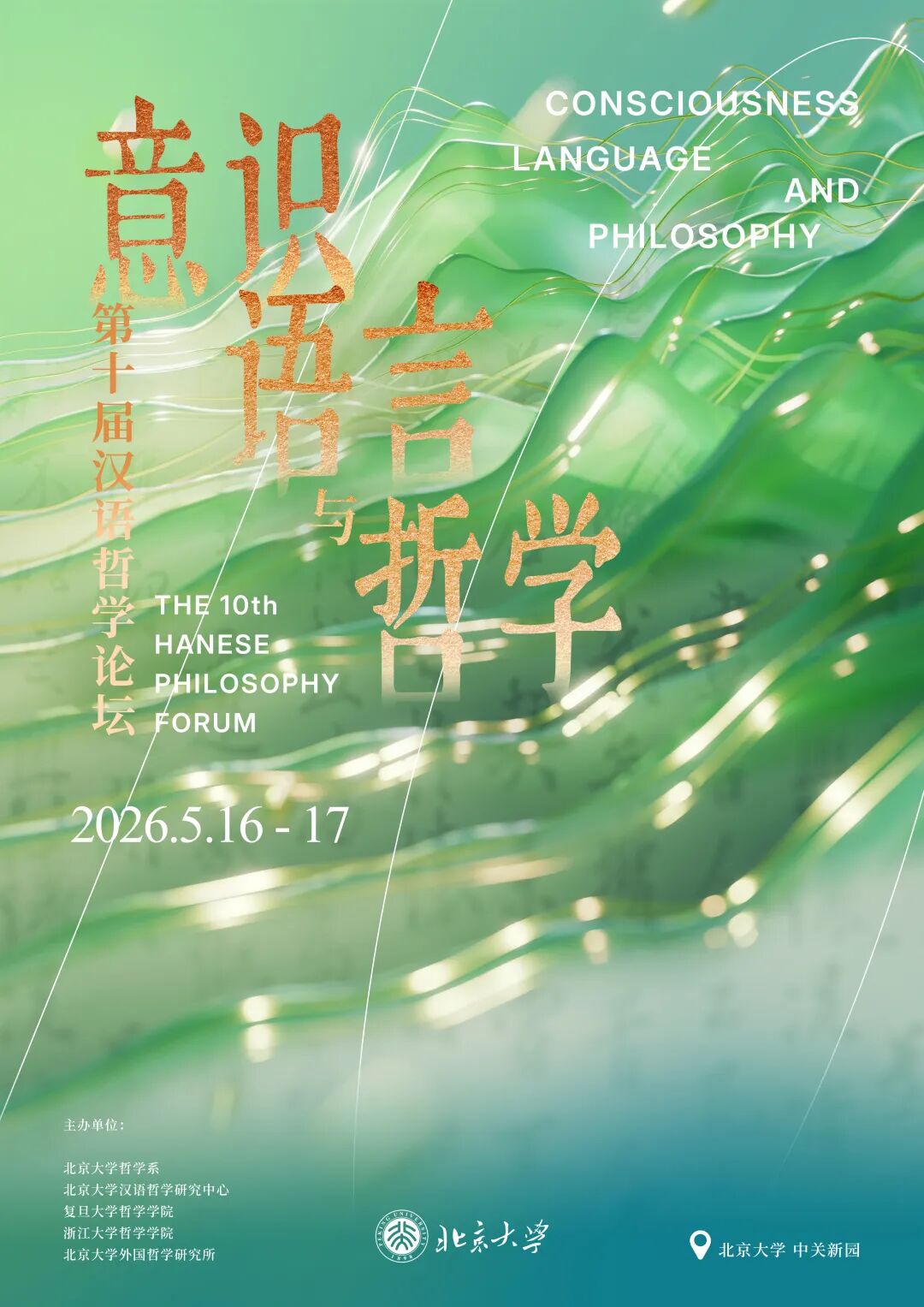


The 10th Hanese Philosophy Forum
Time: Sat-Sun May 16-17 2026
Place: Zhongguanyuan Global Village, Peking University
Abstract:
The concept of Hanese Philosophy was first explicitly proposed at the beginning of this century. It has since generated a sustained and increasingly substantial response within the scholarly community. In May 2016, Peking University hosted the First Conference on Hanese Philosophy. The vigorous exchange of both supportive and critical views on that occasion marked the emergence of Hanese Philosophy as a public field of philosophical discussion. Through continuing reflection and the annual convening of the Conference, what began as a contested proposal has gradually acquired the contours of a recognised field of inquiry and, more significantly, of a distinctive philosophical paradigm.
Today, Hanese Philosophy stands among the most intellectually active developments in contemporary philosophical research. Its questions now extend across a range of philosophical disciplines and approaches, including analytic philosophy in Chinese, phenomenology in Chinese, philosophy of religion in Chinese, and other cognate fields. In this respect, Hanese Philosophy is not simply one additional subfield among others. It also offers an integrative perspective from which the boundaries between philosophical specialisms may be reconsidered, and from which more fundamental and synthetic forms of philosophical investigation may be pursued.
The self-conscious emergence of Hanese Philosophy concerns more than the naming of a discipline or the demarcation of a new academic territory. It brings into view a series of more basic philosophical problems: the relation between mind and language, language and philosophy, language and truth, and, increasingly, language and intelligence. At the same time, Hanese Philosophy remains oriented towards the lifeworld. It asks how the Chinese-speaking world may disclose distinctive forms of spiritual life, modes of reflection, and structures of meaning in response to questions of shared human concern. In doing so, it returns philosophy to some of its most elementary conditions while also opening new paths for conceptual formation, theoretical construction, and cross-traditional dialogue.
The rise of Hanese Philosophy thus testifies to the depth, vitality, and theoretical inventiveness of philosophical thought in China. It reflects not only the capacity to engage the fundamental question of what it means to be human, but also the possibility of developing philosophical concepts and arguments from within a determinate linguistic and cultural world without relinquishing philosophy’s claim to universality.
The Tenth Conference on Hanese Philosophy will be held at Peking University from 15 to 17 May 2026. The Conference aims to review and exchange recent research in Hanese Philosophy, to advance its further development, to extend its conceptual boundaries, and to engage seriously with substantive criticisms and possible challenges. We are pleased to invite scholars from China and abroad to join us in reflecting on the present state of Hanese Philosophy and in considering the directions of its future development.