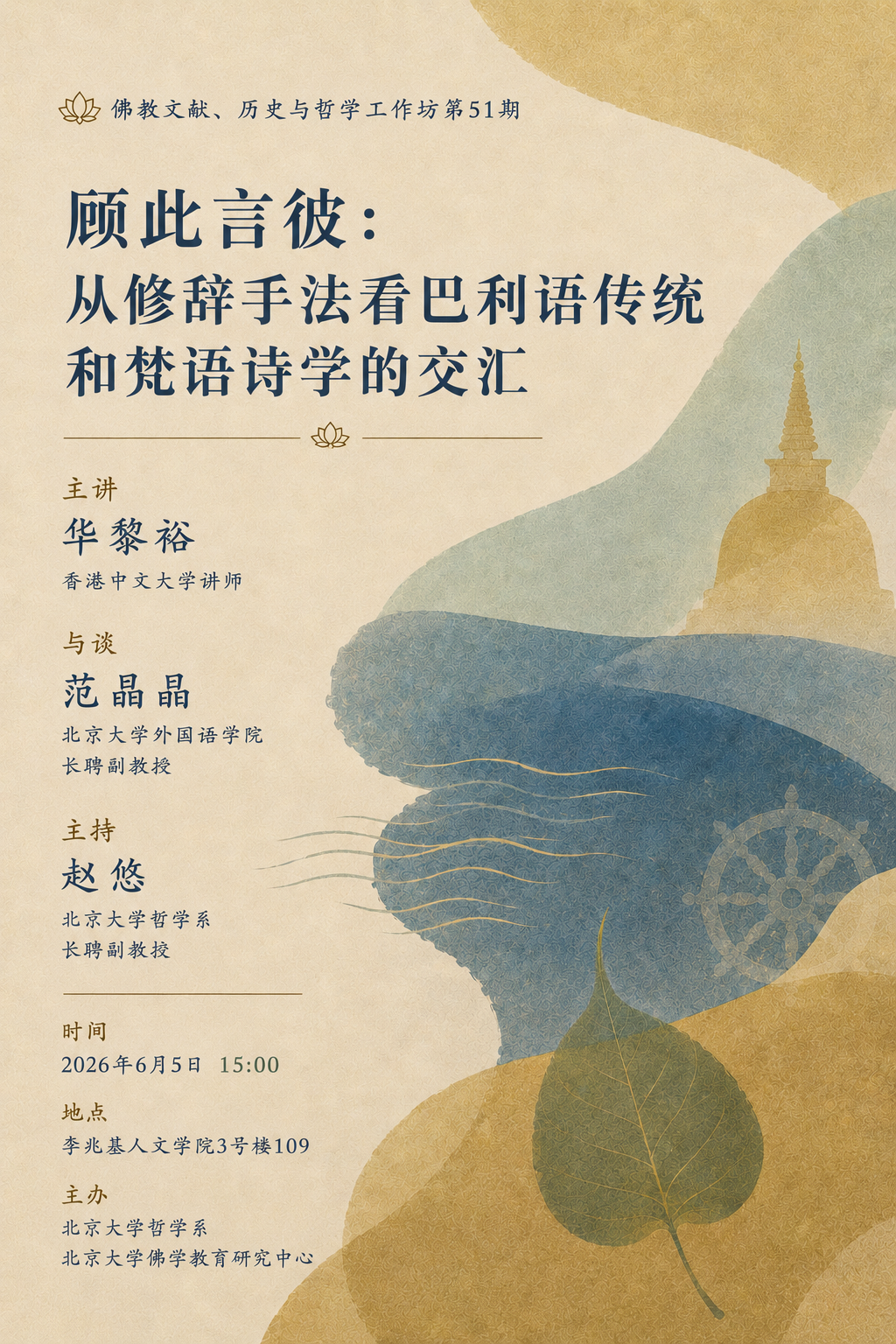


Speaking of One Thing While Meaning Another: The Intersections of the Pali Tradition and Sanskrit Poetics from the Perspective of Rhetorical Devices
Time: Fri 5 Jun 2026, at 15:00
Place: Room 109, Building 3, Lee Shau Kee Humanities Hall
Speaker: HUA Liyu, The Chinese University of Hong Kong
Abstract:
Samāsokti is an ingenious rhetorical device in Sanskrit poetics. After its definition was established by Bhāmaha around the seventh century, the theorist Daṇḍin illustrated its diverse manifestations in poetry and developed a detailed classification of its various forms. The essence of samāsokti may be summarized as “speaking of one thing while meaning another”: the literal meaning of a poem concerns one subject, while its intended referent is something else entirely.
But for readers who lack the relevant context, how can they recognize what the author is really alluding to? And how can worldly language depicting sensual pleasures and everyday experiences be transformed into expressions of Buddhist spiritual guidance?
By examining the creative appropriation of Sanskrit poetics by the twelfth-century Laṅkā Buddhist scholar Saṅgharakkhita, this lecture addresses the above questions. It also explores the possible connections between Sanskrit poetics and the Pali Buddhist tradition, demonstrating how Sanskrit poetics can be useful in both the appreciation and interpretation of Buddhist classics.
“简说”(samāsokti)庄严是梵语诗学中一种巧妙的修辞手法,婆摩诃在公元七世纪前后确定了其定义以后,庄严论者檀丁列举了其在诗歌中多样的表现形式,并对其分类作出了细致的分析。简说庄严可以总结为“顾此言彼”,也就是说,诗歌的字面义讲述的是甲,而实际上真正影射的是乙。但是对于缺少上下文的读者,如何才能领会到作者的“另有所指”呢?声色犬马乃梵语读者所喜闻乐见,描绘此等事物的世俗言语又如何能化用为佛教的“善知识”呢?通过讨论公元十二世纪楞伽佛教学者僧护对梵语诗学的创造性接受,本讲座将解答上述问题,同时也探讨梵语诗学与巴利文佛典可能的渊源,展示梵语诗学有助于欣赏和阐释佛教经典。