


The 103rd Marxist Philosophy Forum
Professor You Xilin on “The External and Internal Ends of Labor: Marx and Aristotle”
On May 8, 2026, from 2:00 p.m. to 5:00 p.m., the 103rd Marxist Philosophy Forum of the Department of Philosophy, Peking University, was held in Room 203, Lee Shau Kee Humanities Building No. 4. The lecture was titled “The External and Internal Ends of Labor: Marx and Aristotle.”
The keynote speaker was Professor You Xilin, Professor of Literary Theory and Aesthetics at the School of Literature, Shaanxi Normal University, Senior Professor of Humanities, Director of the Center for General Education, and doctoral supervisor. Graduate students from the Teaching and Research Section of Marxist Philosophy, together with faculty members and students from outside Peking University, attended the forum. The event was chaired by Professor Yang Xuegong from the Department of Philosophy, Peking University. Before the lecture, Professor Yang warmly welcomed Professor You on behalf of the Department and introduced the background and significance of the topic.
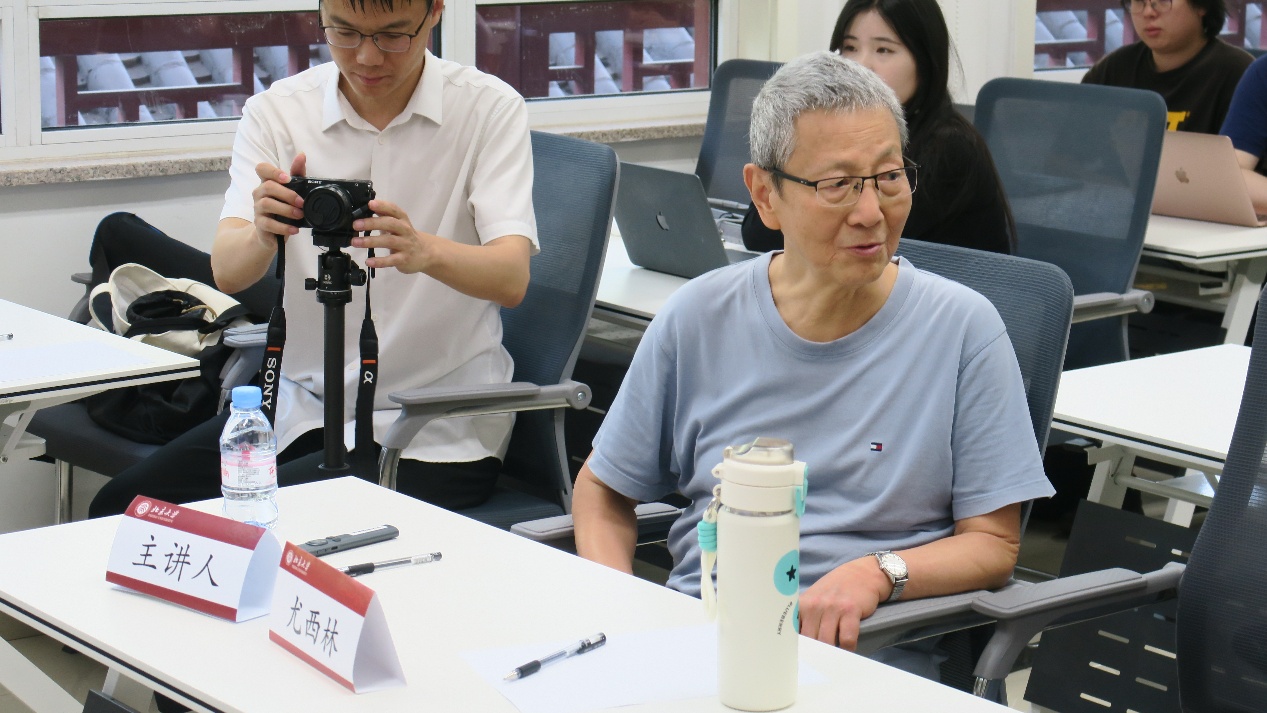
Professor You began by explaining the origin of the question. He noted that Marx called Aristotle “the greatest thinker of antiquity,” yet Marx’s philosophy of labor fundamentally overturned Aristotle’s view of labor. In the twentieth century, Hannah Arendt described Marx as “the greatest modern theorist of labor,” but rejected Marx’s view of labor through a radical Aristotelian framework. According to Professor You, Aristotle’s view of labor, centered on sacrifice, expenditure, and external ends, has shaped the dominant understanding of labor from slavery and wage labor to modern work for livelihood. At the same time, it has also helped produce modern hedonism and nihilism, which reject labor altogether. Against this background, Professor You identified the central thread of the lecture: the changing relation between external and internal ends forms a deep line of transformation in Marx’s philosophy of labor and has become a key issue in the age of artificial intelligence.
Professor You then discussed Aristotle’s view of labor and its external purposiveness. Aristotle understood labor in light of natural essence and regarded the slave engaged in labor as “an instrument for service.” Professor You explained that enslaved labor absorbed one basic feature of productive activity and extended it to all labor: labor is an activity directed toward an external end. Labor has no internal end of its own. It serves as a means to secure food, shelter, and other conditions of survival, thereby supporting activities that do have internal ends. In this sense, it continues the animal mode of existence, namely the condition of the “laboring animal.” Capitalist wage labor further intensifies Aristotle’s externally oriented view of labor into alienated labor opposed to the laboring subject. For the worker, labor becomes something external, involuntary, and compulsory. It becomes only a means to satisfy needs outside labor itself.
Professor You next explained Aristotle’s theory of activities with internal ends and their mechanism of realization, and then discussed how Marx revealed the dual character of the ends of labor. Aristotle’s idea of an “internal end” rests on two dynamic functions. The first is energeia, the activity through which something moves from potentiality to actuality. The second is entelecheia, the capacity of something to move toward the realization of its own internal end in the course of development. Professor You argued that Marx transformed Aristotle’s view of labor as forced sacrifice into a normal and legitimate anthropological need, namely the “metabolism between human beings and nature.” The external end of labor’s objectification is an indispensable structural relation for the objectification of human species-being as an internal end. In Marx’s view, the external and internal ends separated by Aristotle are unified in labor. Labor as energeia produces use value as an external end, while at the same time serving as an objectifying activity of self-realization as entelecheia. The process through which the internal end perfects itself by overcoming the external end is what Marx calls “history.”
The fourth part of the lecture focused on “living labor,” understood as a living unity of the opposition between external and internal ends. The process of living labor is the movement of labor from potentiality to realization. Professor You pointed out that living labor realizes its internal end through objectification directed toward an external end. The mechanism for realizing the external end is what Marx calls the “living, form-giving fire.” This “fire” of living labor is the objectifying mechanism through which human internal ends guide and transform external ends. It shapes not only material objects, but also the means of production, the laborer, all labor-related objects, and collaborators. Labor thus produces a dual existence of external and internal ends: the product as use value and the renewed laboring subject. Fundamentally, the internalization of external ends results from the combination of species-level production and individual activity.
In the final part, Professor You discussed “nature and freedom: the internal ends of historical development and new questions in the age of artificial intelligence.” He argued that artificial intelligence has begun to take over labor procedures directed toward external ends. The foundation and limits of AI require that, after the free individuality of living labor transfers repetitive external-end procedures to AI, the process of realizing external ends must remain controllable and guided by internal ends. The unprecedented growth of productive forces shifts the meaning of external ends from use value to the anthropological relation between human beings and nature. In this sense, the ancient external end of labor points toward the deepest internal end in the age of artificial intelligence.
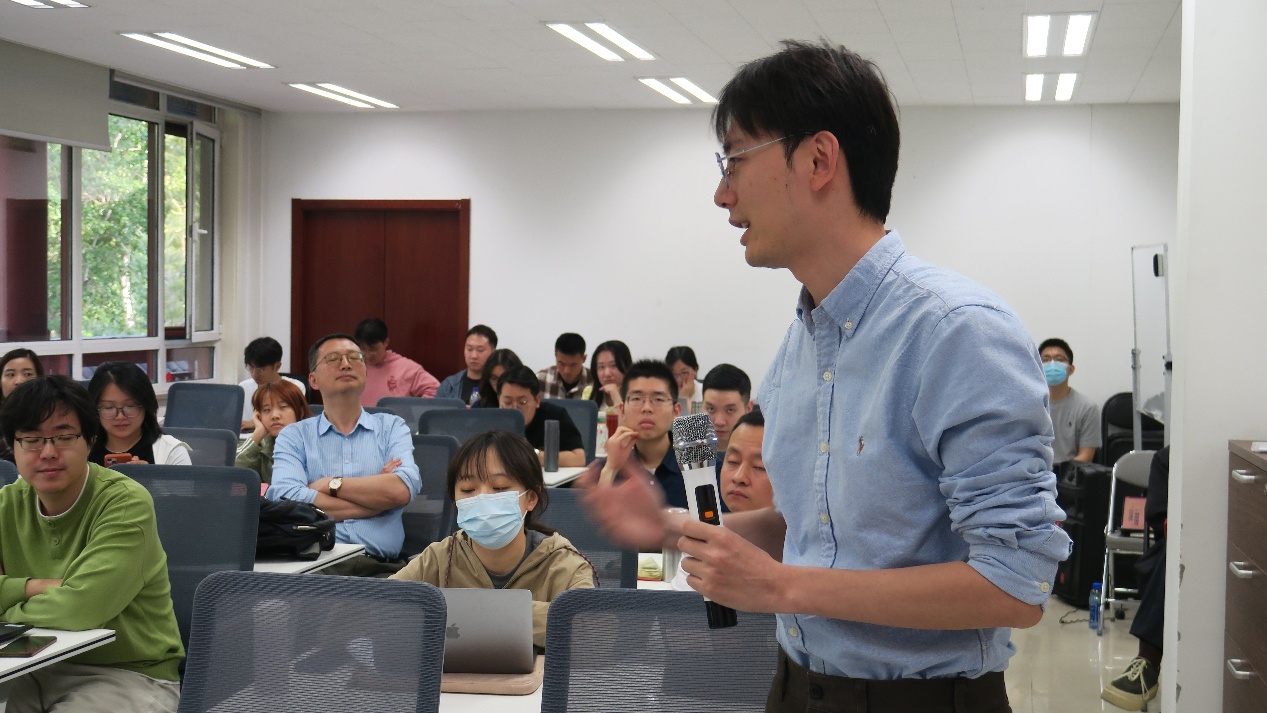
Professor Yang Xuegong highly praised Professor You’s lecture and summarized its main arguments and academic value. He noted that labor is a central issue in Marxist philosophy, and that Professor You’s lecture addressed fundamental theoretical and practical concerns. In the current age of artificial intelligence, rethinking Marx’s view of labor is especially important. Discussant Dr. Zhong Chenning also expressed sincere thanks to Professor You for his insightful lecture. Dr. Zhong noted that the lecture was not only a detailed discussion in intellectual history, but also engaged with issues that remain highly important in contemporary Anglophone Marxist philosophy. The forum concluded with active and enthusiastic exchanges among the audience.

Original Chinese Text by Yu Zhenxiang
Photography by Gong Jingxi
Reviewed by Zhang Wu